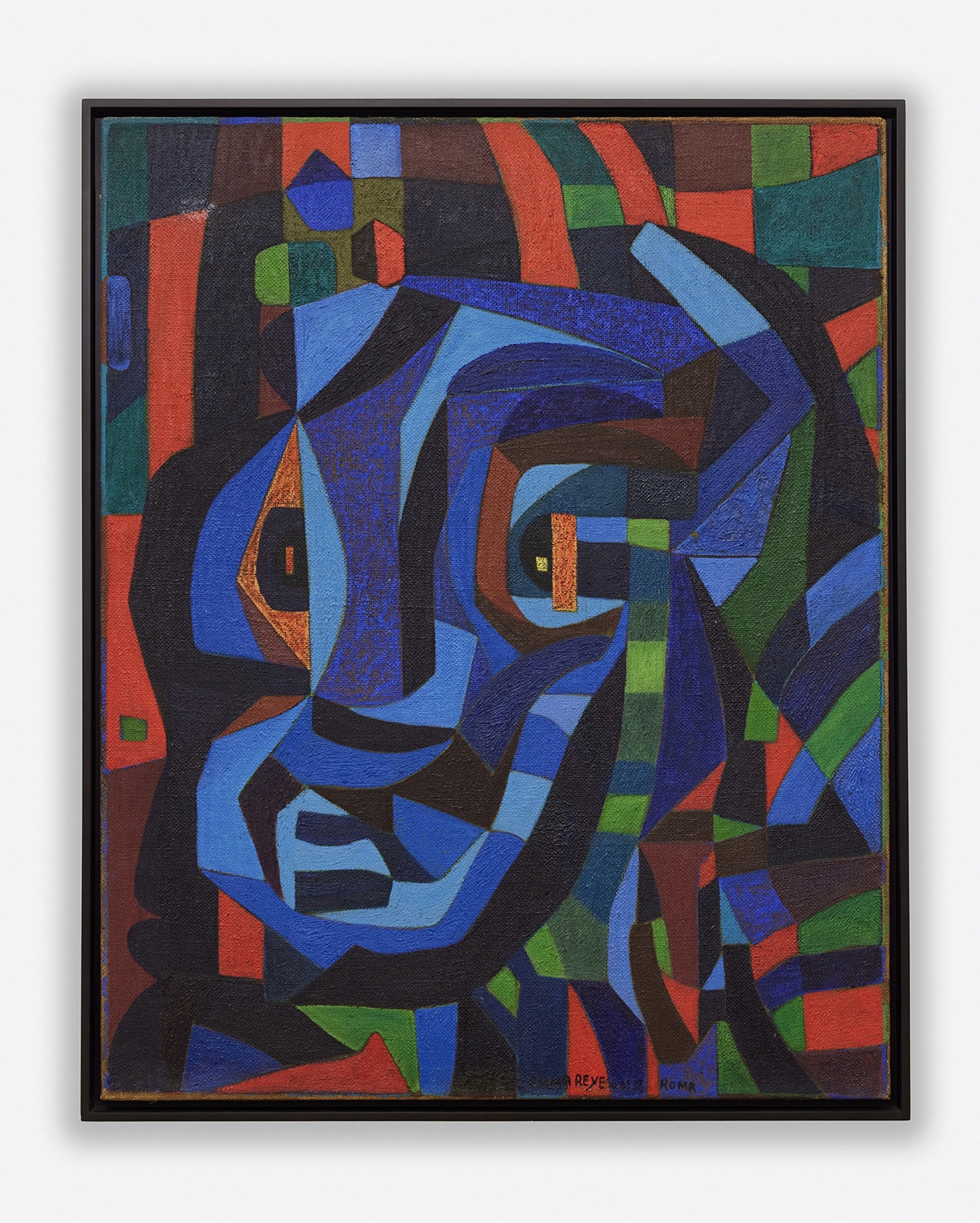
Crèvecœur présente à Frieze Masters une sélection exceptionnelle d’oeuvres inédites d’Emma Reyes (1919–2003), jamais montrées à ce jour : une série de portraits imaginaires en noir et blanc des années 1970 et une pièce majeure de 1954 issue de la série fondatrice des « Monstres », dont le seul équivalent connu est dans la collection du Banco de la República à Bogotá.
C’est à Rome, entre 1954 et 1960, qu’Emma Reyes conçoit sa première tentative pleinement aboutie de réappropriation des formes issues des cultures américaines. Nourrie par l’étude minutieuse des artefacts précolombiens découverts au Mexique sous l’égide de Diego Rivera (qu’elle assista pendant plus d’un an) et par les peintures corporelles rituelles observées chez les populations indigènes, la série des « Monstres » représente les proches de l’artiste — parmi lesquels le peintre futuriste Enrico Prampolini, dont elle est alors la compagne et collaboratrice, et l’écrivain Alberto Moravia — sous les traits d’êtres mi-humains mi-animaux. Si ces toiles résonnent avec le post-cubisme alors en vogue à Rome, elles ne s’y réduisent pas : au-delà du continuum qu’elle établit entre l’humain et l’animal, Emma Reyes y revalorise la part animale en chacun de nous, loin de toute lecture morale ou religieuse de la faute. La toile présentée ici, l’une des rares survivantes de ce corpus fondateur, n’a pour seul pendant connu qu’une oeuvre conservée dans une institution publique colombienne.
Cette hybridation entre espèces, qui trouvera son expression la plus aboutie vingt ans plus tard dans la série tardive des « Masques », se prolonge dès le début des années 1970 dans la première série des « Portraits imaginaires », que notre présentation dévoile ici pour la première fois. Débutée à l’encre de Chine sur papier, en noir et blanc, avant de basculer vers la couleur, cette série révèle la main d’une artiste formée à la broderie au couvent des Soeurs auxiliatrices de Bogotá, où elle fut recluse enfant plus de dix ans. On y perçoit un jeu de fils et de lignes tendues qui s’opposent pour animer et faire vibrer la surface, dans un esprit proche de l’Op Art — une surface tissée qui construit sa profondeur sans recourir à la perspective occidentale. Par cette ligne baroque et déformante qui caractérisera son oeuvre pendant vingt ans, Emma Reyes évoque la compagnie immémoriale des espèces : bouches qui se muent en corolles de champignons, yeux qui évoquent des boutons de rose ou des nébuleuses — une oscillation constante entre l’infiniment petit et l’infiniment grand, entre poussière d’étoile et mitochondrie.
Restées dans le fonds de proches de l’artiste et absentes de toute exposition à ce jour, ces oeuvres offrent un accès rare et direct au laboratoire graphique d’une artiste dont l’oeuvre, longtemps restée dans l’ombre, connaît depuis 2023 (rétrospective au MAMCO de Genève) une redécouverte majeure, après la grande exposition que Crevecoeur lui a consacrée en 2025. Cette présentation fait suite à la première exposition d’Emma Reyes au Royaume-Uni, actuellement présentée à White Cube à Londres.
 Loading