Crèvecœur

Menu
Artists
Top

Daisuke Fukunaga

Waiting as Time Shifts, 5 & 7 rue de Beaune, Paris

text Press

La main à plume vaut la main à charrue.
- Quel siècle à mains !
Rimbaud, Une saison en enfer, 1873


Les directeurs les ouvriers et les belles sténo-dactylographes
Du lundi matin au samedi soir quatre fois par jour y passent
Le matin par trois fois la sirène y gémit
Une cloche rageuse y aboie vers midi
Apollinaire, Zone, Alcools, 1913


Un homme qui dort tient en cercle autour de lui
le fil des heures, l’ordre des années et des mondes.
Marcel Proust, Du côté de chez Swann, 1913


Je préfère le bizarre au plat.1
Girodet


Waiting as Time Shifts est la première exposition de Daisuke Fukunaga à la galerie. Précédemment, il faisait partie du casting insolite de Mon chérie Coco, à l’Institut français de Tokyo2, exposition elle-même imaginée comme une suite de The Sentimental Organization of the World3, organisée à la galerie en 2020. Diplômé de la Tama Art University au tournant des années 2000, Daisuke Fukunaga circule librement, presque distraitement, entre l’héritage du nihonga et du yōga, les animés de son enfance et son expérience personnelle, ancrée tôt dans le travail : il a fait plusieurs petits boulots, photographe
dans un studio de portraits de famille, cartographe pour Google, ouvrier dans une usine d’incinération de déchets… Cette expérience, doublée d’une observation quotidienne des gens qui travaillent, est devenue le sujet de son métier principal : la peinture. La main à pinceau vaut la main à balai, oserait-on dire ici à la suite de Rimbaud. Une saison en enfer est publiée en 1873, en plein « siècle à mains ».
Si en France le temps n’est pas encore réglé partout de la même façon, c’est précisément cette année-là que le Japon adopte les heures égales de vingt-quatre heures, ainsi que le calendrier grégorien, faisant disparaître brutalement les heures variables et ouvrant la voie à un travail strictement mesuré et allongé.


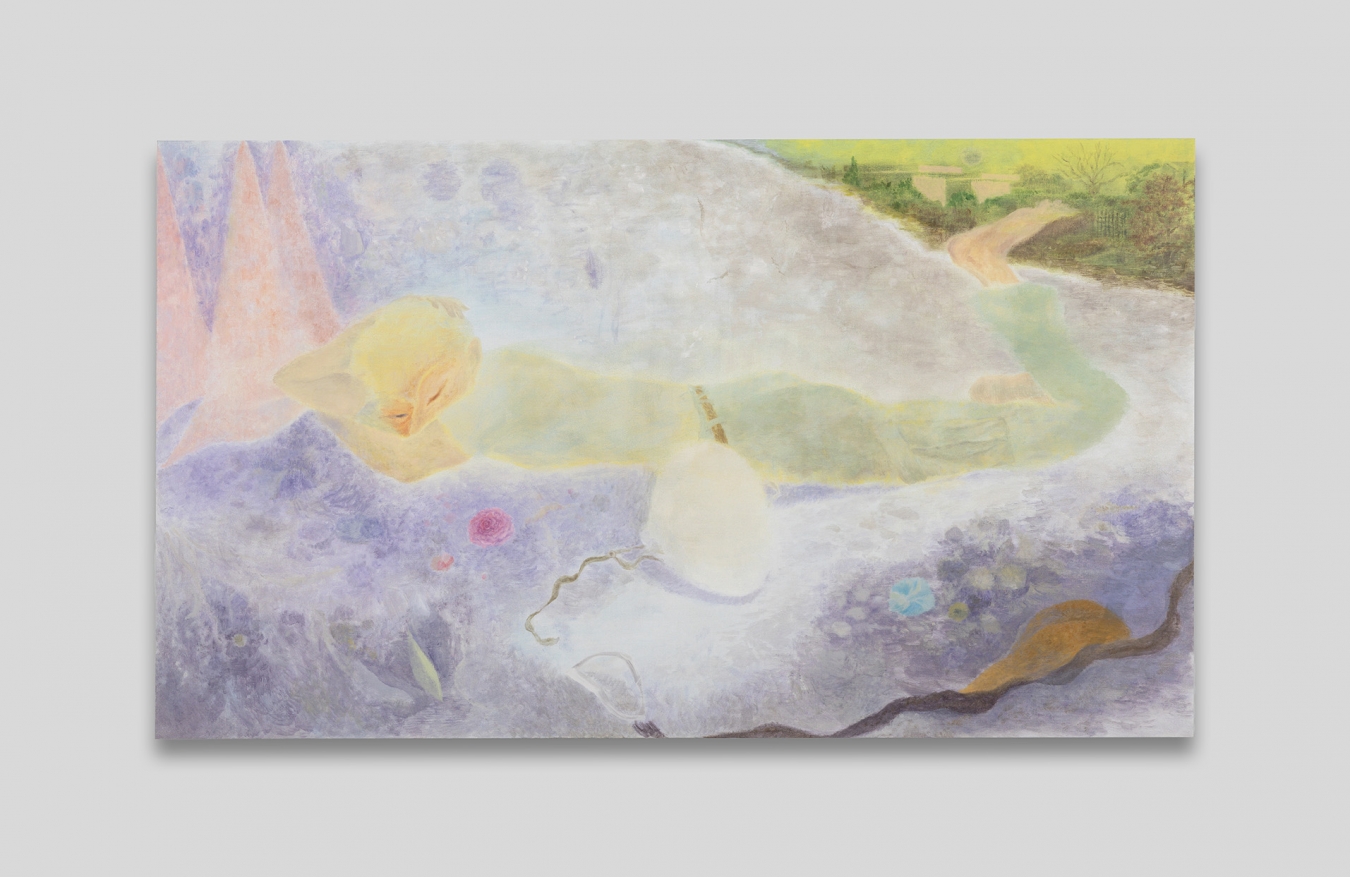
Chez Daisuke Fukunaga, on se situe pourtant bien loin de tout réalisme social. Les peintures de l’exposition, vaporeuses, à la lumière diffuse, composent un ensemble flottant, comme suspendu hors du temps des horloges, où le travail n’est plus qu’un point de départ.
Vues souvent en plongée, les figures s’enfoncent dans une autre durée, loin du gémissement de la sirène d’Apollinaire. Leurs corps coulent doucement dans la brume ou le rêve, tandis que les outils, une faucille, un gant, un balai, une débroussailleuse, semblent rester, plus nets, à la surface du tableau. Une surface mate, à la peinture mince, comme lavée, où le grain de la toile se devine. Les souvenirs, dit l’artiste, finissent toujours par « remonter à la surface », en peignant comme en regardant un tableau4. L’artiste dit lui-même que les mouvements des gens au travail correspondent à leur métier, mais que c’est dans les attitudes de repos, de pause, qu’on sent poindre la personnalité de chaque individu5. Il le décrit d’ailleurs à propos de lui-même : au travail, il s’absorbe dans sa tâche, puis il fait une pause, son regard se trouble, et il commence « à se fondre dans le lieu qui l’entoure ». « J’ai l’impression qu’un autre monde s’ouvre. »6 Cette plongée volontaire dans ce qui échappe aux normes et aux contraintes est bien ce qui tient sa peinture. À rebours du travailleur héroïque, en plein effort, qui a peuplé la
peinture française du XIXe siècle, l’employé est ici, souvent, alangui.


En posant des couleurs qui n’ont plus rien à voir avec les lieux figurés, dans un espace déformé comme par un champ magnétique7, Fukunaga plonge ses sujets et ses objets dans un monde fictif, peut-être utopique, comme dans Melt Into Surrender, où l’horloge flotte et ne commande plus, comme dans At the Edge of a Dream, où la barrière du rêve envahit l’espace. Un espace liminal où les « machines de chair et d’os »8 sont enfin à l’arrêt, representé avec grace évanescente dans Golden Time.
C’est peut-être ici, dans ces peintures qui, comme Girodet, préfèrent le bizarre au plat, et où les personnages s’absentent, ne consomment rien et semblent ne rien produire, que se joue quelque chose de notre époque, qui a fini par faire du repos lui-même une tâche à accomplir. À les regarder, on reprend le fil des heures, celui des années et des mondes dont parlait Proust, et l’on entrevoit ce que dit le peintre : face au temps qui se déplace, on se sent « relié à quelque chose »9, qui nous précède et
nous survivra.


  1. Formule que Girodet répétait souvent à ses élèves, citée dans le catalogue de l’exposition Girodet, 1767-1824, sous la direction de Sylvain Bellenger, Paris, musée du Louvre / Gallimard, 2005.
  2. Mon chérie Coco, Institut français de Tokyo, 2024, exposition conçue avec la complicité de Naoki Sutter-Shudo et Ernst Yohji Jaeger, avec la participation de Yoshitaka Amano, Julien Ceccaldi, Koichi Enomoto, Léonard Foujita, Daisuke Fukunaga, Yasuaki Hamada, Hanayo, Kyoko Idetsu, Ernst Yohji Jaeger, Marie Laurencin, Jonny Negron, Yu Nishimura, Alexandra Noel, Louise Sartor, Setsuko, Naoki Suter-Shudo.
    3 The Sentimental Organization of the World, Crèvecoeur, Paris, 2020, exposition co-organisée avec Naoki Sutter-Shudo, avec la participation de C-Brushammer, COBRA, Miho Dohi, Kenji Ide, Ulala Imai, Soshiro Matsubara, Julien Monnerie, Koji Nakano, Yu Nishimura, Alexandra Noel, Louise Sartor, Hiroshi Sugito, Naoki Sutter-Shudo, Yui Yaegashi.
    4 Daisuke Fukunaga, notes pour l’exposition Waiting as Time Shifts, 2026. Traduit de l’anglais.
    5 Propos de l’artiste, communiqué de l’exposition Labor, Tomio Koyama Gallery, Tokyo, 2020.
    6 Daisuke Fukunaga, notes pour l’exposition Waiting as Time Shifts, op. cit.
    7 Communiqué de l’exposition Labor, Tomio Koyama Gallery, Tokyo, 2020.
    8 Paul Lafargue, Le Droit à la paresse, 1880, chapitre III.
    9 Daisuke Fukunaga, notes pour l’exposition Waiting as Time Shifts, op. cit.
A hand that holds a pen is worth a hand that holds a plow.
- What a century for hands!
Rimbaud, A Season in Hell, 1873. Translated by Paul Schmidt.


Executives labourers exquisite stenographers
Criss-cross Monday through Saturday four times daily
Three times every morning sirens groan
At the lunch hour a rabid bell barks
Apollinaire, Zone, Alcools, 1913


A sleeping man holds in a circle around him the sequence of the hours,
the order of the years and worlds.
Marcel Proust, Du côté de chez Swann, 1913


I prefer the bizarre to the bland.1
Girodet


Waiting as Time Shifts is Daisuke Fukunaga’s first solo exhibition at the gallery. He was previously. a part of the unusual line-up of My Chérie Coco at L’Institut français in Tokyo2, an exhibition that was itself the continuation of The Sentimental Organisation of the World3, held at the gallery in 2020. Since graduating from the Tama Art University in the early 2000s, Fukunaga has continued to roam freely, almost distractedly, amongst the heritage of nihonga and yoga, the anime of his childhood and his personal experience - an early anchoring point for his work - including his many side jobs: photographer at a studio of family portraiture, cartographer at Google, worker at a waste incineration facility… This experience, when doubled with his everyday observation of working people, becomes the subject of his main profession: painting. A hand that holds a brush is worth a hand that holds a broom, so one could dare say after Rimbaud. A Season in Hell was published in 1873, right in the middle of that “century of hands.” If in France, time isn’t yet completely synchronised throughout the territory, in Japan, in that exact year, the country adopted the fixed 24-hour day, as well as the Gregorian calendar, thus brutally losing all hourly variation, paving the way for a longer and quantifiable working day.


In Fukunaga’s work, we are however very far from any notion of social realism. The ethereal paintings in the exhibition, their soft light, make for an untethered ensemble, drifting outside of measured time, where work is merely a point of departure.
Often viewed from above, his figures are engulfed within another kind of duration, far from Apollinaire’s groaning siren. Their bodies flow gently into fog or dream, while tools - a sickle, a glove, a broom, a strimmer - seem to remain in focus, on the surface of the work: a matte, thinly-painted surface, as though washed, where the weave of the canvas can be glimpsed. Memories, the artist says, eventually rise to the surface, painting and observing the work at the same time.4 The artist says himself that while each profession has its own gestures, it’s in a worker’s attitude, in their moments of rest, that their own personality appears.5 He even says it about himself: when at work, he becomes absorbed in a task, then takes a break, his eyes glaze over, and he starts to “merge with the place around him” “I feel as though another world opens up.”6 This deep and deliberate evasion of norms and constraints is exactly what gives his paintings their particular colour. Contrary to the heroic, toiling worker - who populated nineteenth century French painting for example - the employee, here, is often languorous.


Through using colours unrelated to the places that they depict - space deformed as though by a magnetic field7 - Fukunaga plunges his subjects and objects within a fictional world, a utopia even, where clocks no longer master time and instead float, like in Melt into Surrender. Where the edges of a dream invade space, like in At the Edge of a Dream. Where “machines of flesh and blood”8 suspended in liminal space, are turned off at last, like in the largest painting in the exhibition: Golden Time. In these paintings that “prefer the bizarre to the bland,” as Girodet once said - where figures go away, consume nothing, and don’t produce anything either - one can start to sense our contemporary era, which has made rest just another task to tick off a list. Looking at Fukunaga’s work, the sequence of hours - of years and worlds, as Proust wrote - we glimpse the painter’s words: confronted with passing time, we feel “connected to something”9 that exists before us, and beyond us.


Translated by Aodhan Madden

  1. An expression that the painter Girodet often repeated to his students, quoted in the exhibition catalogue Girodet, 1767-1824, edited by Syvain Bellenger, Paris, Musée du Louvre, Gallimard, 2005.
  2. Mon Chérie Coco, Institut français, Tokyo, 2024, exhibition conceived alongside Naoki Sutter-Shudo and Ernst Yohji Jaeger, featuring works by Yoshitaka Amano, Julien Ceccaldi, Koichi Enomoto, Léonard Foujita, Daisuke Fukunaga, Yasuaki Hamada, Hanayo, Kyoko Idetsu, Ernst Yohji Jaeger, Marie Laurencin, Jonny Negron, Yu Nishimura, Alexandra Noel, Louise Sartor, Setsuko, Naoki Sutter-Shudo.
  3. The Sentimemental Organisation of the World, Crèvecoeur, Paris, 2020, organised with Naoki Sutter-Shudo, featuring works by C-Brushammer, COBRA, Miho Dohi, Kenji Ide, Ulala Imai, Soshiro Matsubara, Julien Monnerie, Koji Nakano, Yu Nishimura, Alexandra Noel, Louise Sartor, Hiroshi Sugito, Naoki Sutter-Shudo, Yui Yaegashi.
  4. Daisuke Fukunaga, notes for Waiting as Time Shifts, 2026.
  5. As expressed by the artist in the press release for Labor, exhibition at Tomio Koyama Gallery, Tokyo, 2020.
  6. Daisuke Fukunaga, notes for Waiting as Time Shifts, 2026.
  7. Press release for Labor, Tomio Koyama Gallery, Tokyo, 2020.
  8. Paul Lafargue, Le Droit à la paresse [The Right to Laziness], 1880, chapter III.
  9. Daisuke Fukunaga, notes for Waiting as Time Shifts, 2026.
Il Giornale dell'Arte
Waiting as Time Shifts Loading